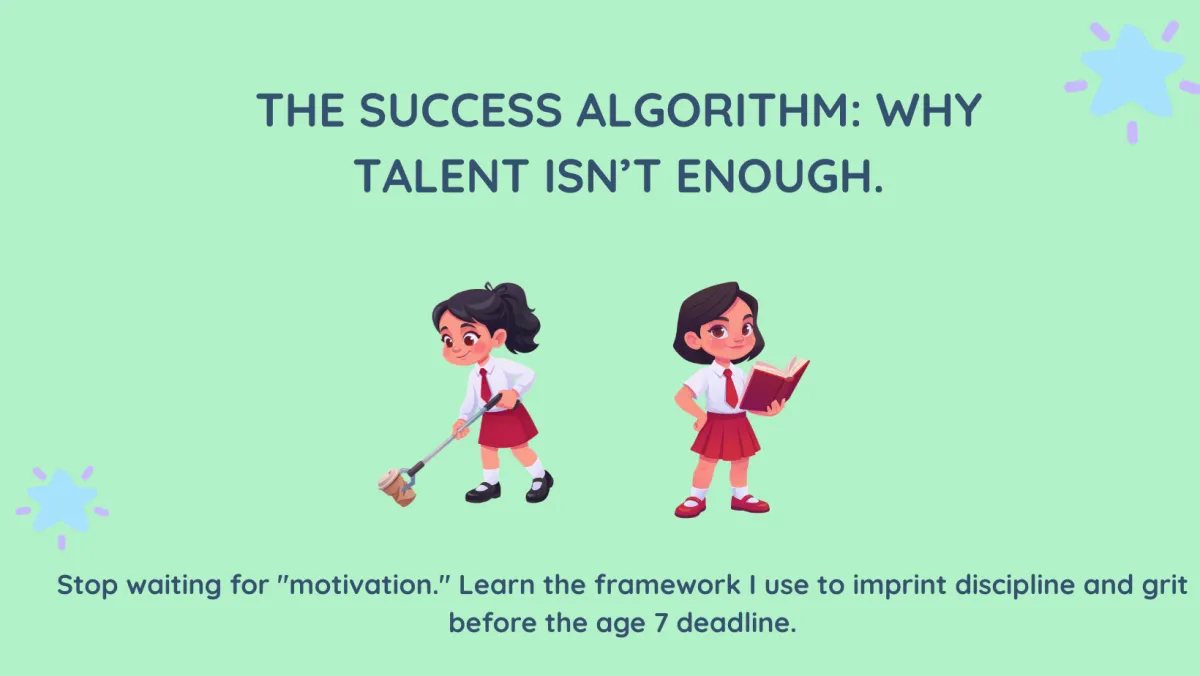
Why I’m Teaching My Daughter to "Ignore the Emotion" (and Why I Wish Someone Taught Me)
I used to think being "gifted" was enough. Growing up, school was easy for me. I’m a visual learner with a photographic memory; I could watch a lesson once or breeze through a chapter and "get it" without ever breaking a sweat.
But then I hit college, and the "Easy Button" broke.
Because I never learned discipline as a child, I had no systems for when things got hard. I became a procrastinator, living in a constant state of anxiety, pulling all-nighters just to keep my head above water. I had the talent, but I didn’t have the Success Algorithm.
Now, as a parent, I’m looking at the data. I know that by Age 7, a child’s inner voice is largely set. I don't want my daughter to rely on "feeling motivated", I want her to have the grit to follow through when the novelty wears off.
The Strategy: Ignore the Emotion, Follow the Plan
In our house, we’ve officially rebranded how we handle hard tasks. I’ve realized that motivation is a fair-weather friend. Instead, we practice a new rule: Ignore the emotion, follow the plan.
Whether it’s making the bed or finishing a task, the "plan" is the constant. The "emotion", the I don’t feel like it or the this is boring, is just noise. By teaching her to bypass that noise now, I’m helping her build the Adversity Quotient (AQ) she’ll need to lead later.
Identity Imprinting: The Self-Fulfilling Prophecy
You’ll see a specific line throughout my book, Big Dreams, Tiny Steps: "You make great choices all day long."
Does a toddler always make great choices? Of course not. They try to eat things they shouldn't and test every boundary they can find. But I say it anyway. Why? Because of Identity Imprinting.
When we narrate their lives with the assumption that they are capable, disciplined, and wise, they begin to believe it. Eventually, that belief becomes their reality.
From One Parent to Another...
I know it’s tempting to just "do it for them" because we’re tired and it’s faster. I still struggle with this myself. But every time I step back and let her complete a Mastery Experience, even if it’s messy, I’m installing the tools she needs to be a thriving adult who can choose her own path.
We have a short window before that age 7 deadline. Let’s make sure the voice in their head is one of power, not procrastination.
Want to start imprinting these habits during your bedtime routine tonight?


