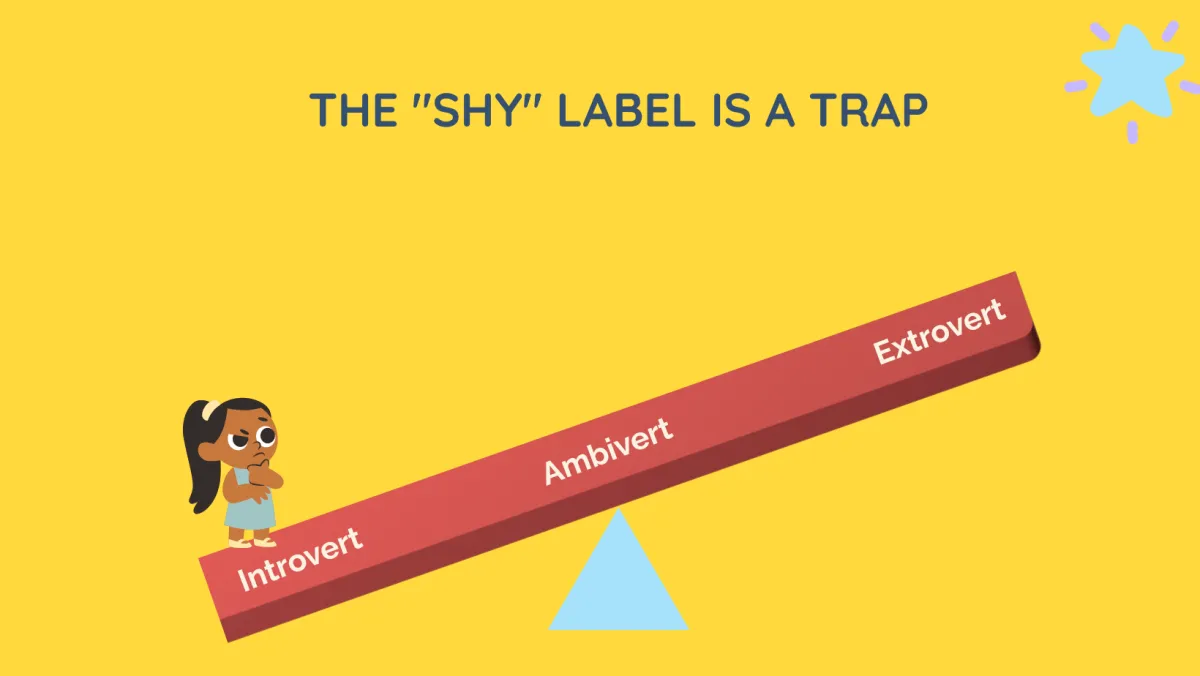
Why the "S-Word" is Banned in Our House
When someone calls my daughter "shy," I don't just smile and nod. I immediately correct the narrative.
"She isn’t shy," I say. "She is observant. She likes to acclimate to new environments before she decides how to engage."
I’m not being difficult; I’m being a Mindset Architect. As a former executive career coach, I’ve spent years helping high-level professionals "unlearn" labels they were given at age three. I’m using data to ensure my daughter never has to do that.
The "Extrovert" Mask and the Ambivert Reality
For a long time, I thought I was a natural extrovert. As a child, I had to translate for my immigrant mother and speak up for my family in high-stakes situations. I was forced to be "out there."
It wasn't until later in life that the mask fell off. I realized I’m actually an Ambivert. I can thrive socially, but it drains me. I wasn’t a "natural extrovert"; I was a child with a heavy amount of responsibility.
Wharton’s Adam Grant has proved that Ambiverts, the 66% of us in the middle, actually make the best leaders. By protecting my daughter from the "shy" label, I am giving her the space to recharge when she needs to and lead when she’s ready.
The Science: Why Labels are a Trap
Research shows that "Shy" is a label that sticks like glue, and once accepted, it becomes a self-fulfilling prophecy. Here is the science behind why we ban the S-Word:
Overprotective Reinforcement: According to the Journal of Child Psychology and Psychiatry, labeling a child "shy" often leads to overprotective parenting. This accidentally robs the child of social agency and reinforces their fear rather than helping them overcome it.
Biology vs. Destiny: Harvard’s Jerome Kagan found that while 20% of babies are "high-reactive" (sensitive to new things), they aren't "destined" to be shy. By changing how we describe their caution, we help them transition from "reactive" to "assertive".
The Judgment Trigger: When we label a child's observation as "shyness," we teach them that caution is a weakness. We teach them to fear social judgment before they even know what it is.
Reframing the Narrative
In our house, we don't box her in. We use language that expands her. We acknowledge her process through a leadership lens:
She is Assessing: She is gathering data on her environment.
She is Recharging: She is protecting her energy.
She is Self-Led: She decides when she is ready to engage; she doesn't do it just because an adult is hovering.
The Mission
This is the core philosophy behind my book, Big Dreams, Tiny Steps. I don't use limiting labels; I use Identity Affirmations.
I want my daughter to grow up knowing that her "caution" is actually discernment, and her "quiet" is actually focus. Whether she ends up being the life of the party or the quietest person in the library, I want that to be her choice, not a label she was handed when she was two.
She isn't shy. She is a self-led leader deciding exactly how she wants to show up in the world. And I’m going to make sure no one tells her otherwise.
Executive Summary for Parents:
Correct the Labeler: When a stranger or relative uses a limiting label, gently provide a "Leadership Rebrand" (e.g., "Observant" or "Acclimating").
Respect the Battery: Acknowledge that social energy is a finite resource, especially for the 66% of us who are Ambiverts.
Focus on Agency: Let the child decide when to engage. Forcing interaction often reinforces the very "shyness" we try to avoid.
As a Mindset Architect, you have the power to design the internal voice your child will carry into adulthood. Don’t let "Shy" become their self-fulfilling prophecy.
I wrote Big Dreams, Tiny Steps to give you the exact identity affirmations needed to turn "caution" into discernment and "quiet" into focus.


