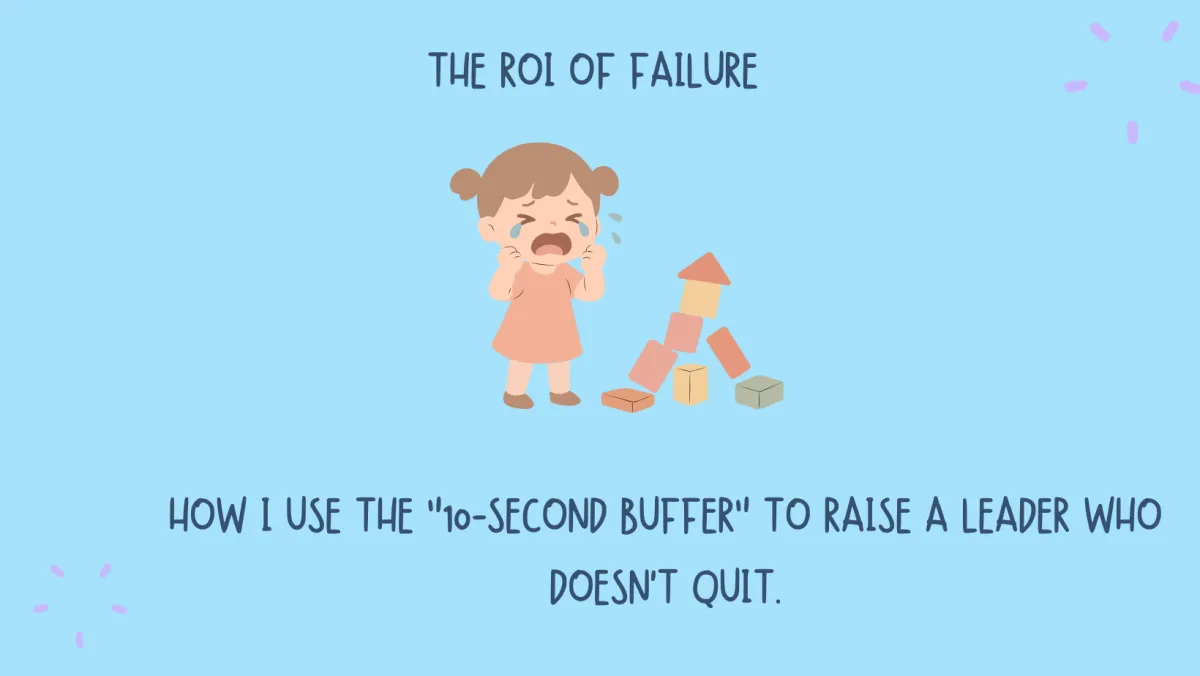
Why I’m Investing in My Daughter’s Failures (And Why You Should Too)
In the corporate world, we talk about "Failing Fast" as a competitive advantage. Venture capitalists don’t look for founders who have never failed; they look for the ones who have failed, learned, and pivoted. Why? Because failure is the most expensive and effective "data point" a leader can collect.
But as parents, we tend to do the exact opposite.
We see our child struggling to fit a square peg into a round hole, or watching their block tower wobble, and our instinct is to "save" them. We reach in, stabilize the tower, and fix the problem.
We think we’re being helpful. In reality, we are inadvertently training them to fear the struggle. We are teaching them that when things get hard, someone else will (and should) swoop in to fix it.
If we want to raise the next generation of leaders, the 1% who are resilient, innovative, and courageous, we have to stop protecting them from failure and start investing in it.
"The 10-Second Buffer" Protocol
In our house, I use a strategy I call the "10-Second Buffer". It’s about being present enough to provide safety, but distant enough to allow for grit. Here is how it works:
1. The Observation Gap When my daughter hits a wall, whether it’s a difficult puzzle or a stubborn pair of socks, I don’t intervene immediately. I wait. I give her 10 seconds of "uncomfortable" silence. This is the space where her brain has to switch from frustration to problem-solving. This is where innovation begins.
2. Shifting from Labels to Data When the tower eventually falls, I don't just say "It’s okay." I say, "That's okay, that didn't work. What should we do differently?" By treating the failure as a data point rather than a disaster, I am building her Adversity Quotient (AQ). I want her to see failure not as a reflection of her worth, but as an essential part of the process.
3. The Mastery Experience Real confidence isn't built on empty praise like "Good job." It is built through Mastery Experiences, the memory of a time you struggled, failed, tried again, and eventually succeeded. When I let her fail at the small stuff now, I am giving her the "proof" she needs to handle the big stuff later.
Why Grit is a Leadership Requirement
A leader who has never failed is a leader who will crumble at the first sign of a market shift. Resilience isn't a personality trait you’re born with; it’s a muscle that must be intentionally broken down to grow back stronger.
Most people want "Good Kids", children who follow instructions perfectly and don't make mistakes. But compliance is the enemy of innovation. I don't want a child who is afraid to be wrong; I want a leader who is brave enough to try again.
I wrote Big Dreams, Tiny Steps because the words we use during these moments of struggle become their permanent inner voice. When we tell our children, "You are smart and strong," we are giving them the internal narrative they need to stand back up when the world tries to knock them down.
We aren't just reading a story at bedtime. We are imprinting a narrative of power. I’m letting her fail today so she has the grit to lead tomorrow.
Raise a Leader, One Word at a Time
The words we use during these moments of struggle become our children's permanent inner voice. If you want to move past "Good Job" and start building a narrative of true confidence, I’ve created a tool to help.
Big Dreams, Tiny Steps is designed to help you imprint the language of resilience and agency before age seven. It’s more than a bedtime story; it’s a daily practice in building a limitless mindset.


